
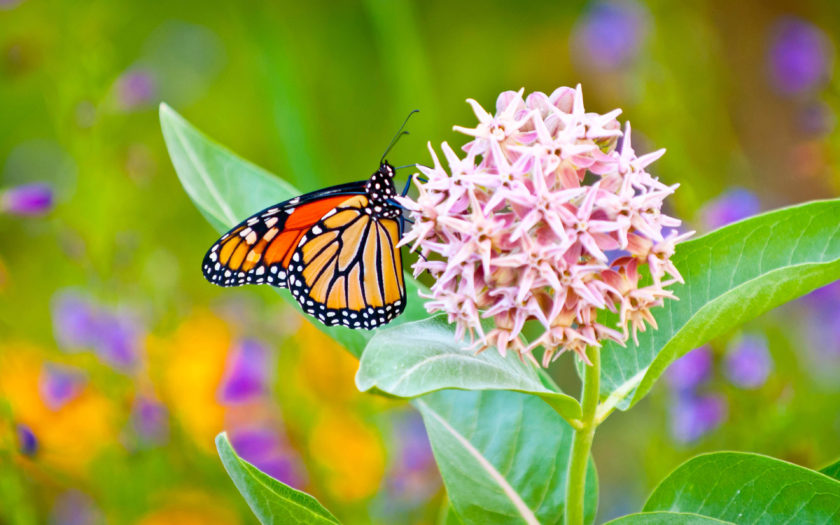
Of the cast of characters in our story, the monarch butterfly is one most familiar to North Americans.
This butterfly is beautiful, sure. But it also has a fascinating life, it’s a great example of specialization, and… it’s even humanity’s hero in a post-apocalyptic graphic novel. Let’s learn more about this wandering beauty!
Life as a Monarch
Two major populations of monarchs exist in North America: the western population (found west of the Rocky Mountains) and the eastern population (east of the Rockies to the Atlantic). The eastern population famously migrates thousands of miles each year from Canada and the United States all the way to overwintering sites in Mexico.
But did you know it takes four generations of monarchs per year to complete the eastern migration? And did you know that the first, second, and third generations live about 4 weeks each, but the fourth generation lives up to 8 months? This last generation is called the “super generation” for this reason. It also migrates much further than the other three. In the fall, it travels from as far as Canada all the way to Mexico, where it spends the winter. In the spring, the super generation begins the return north to breed, lay eggs, and die. Their eggs hatch into the first generation of the new year. Generations one through three make their way back north, where the fourth (or occasionally fifth) generation is born, and the cycle repeats. Check out this handy graphic from the U.S. National Park Service:

Crazy, right? Can you imagine if every fourth generation of humans lived 600+ years so they could carry out an insanely long trip to meet up for a mass outdoor slumber party? But that’s not all.
The super generation also has to find a place that’s warm enough to survive the winter, but cool enough to put them into a sort of hibernation mode so they can last that long. The site also needs to be densely wooded enough to provide shelter from storms and moist enough to avoid drying out the monarchs over the winter. There aren’t tons of places that meet these needs, but certain forests in central Mexico do. Monarchs congregate by the thousand, even millions, here.
Here’s the thing, though. Conservationists estimate the eastern monarch population by hectare (that’s equivalent to 10,000 square meters, or roughly 2.5 acres), and the 2023-2024 population is the second lowest on record, coming in at 0.90 hectares (graph from MonarchWatch.org).

Let’s pause our story to consider the numbers. If one hectare is about 2.5 acres, that means the population of the Eastern monarch fit in the equivalent of about 2.2 acres this year. Most suburban neighborhoods are way bigger than that!
What about the western monarchs? Are they doing better? They’re actually doing worse. Western monarch populations, which largely overwinter in California, were estimated to be 3-10 million strong in the 1980s. Yet less than 250,000 were counted for the 2023-2024 season. That’s less than 9% of even the lowest 1980s population estimate. In other words, the western population has lost more than 90% of its members since the 1980s, while the eastern population has lost an estimated 80% in that timeframe.
What caused these populations to fall so drastically? The primary culprit is loss of habitat, or more specifically, the loss of milkweed.
Specialization and Milkweed
Monarchs depend on milkweed plants for survival. Increasing use of herbicides has wiped out more and more milkweed habitat in the last several decades, with a corresponding drop in monarch populations. (If you’re curious for more details on how habitat loss and other factors threaten monarchs, see this 2014 petition to protect the monarch under the Endangered Species Act.)
Wait, we’ve seen monarch butterflies drink nectar from other plants! Why can’t they just use other flowers instead? Should we coddle such picky eaters?
Good question! While adult butterflies can and do use nectar from a variety of plants, monarchs only lay eggs on milkweed plants. And why are they so selective about their choice of nursery? Because monarch caterpillars can only eat milkweed leaves.
Okay, but again, why coddle picky eaters?
There are two answers to this question. First, monarch caterpillars aren’t really that picky since there are dozens of different milkweed species native to North America, and monarch caterpillars use lots of them as host plants. (And our own species depends exclusively on milk or a close imitation formula the first months of our lives, so we’re not here to judge you, monarchs.)
Second, plants don’t actually love being eaten, and they’ve evolved many ways to kill those who try. Milkweed is no exception. It gets its name from the milky latex that seeps out when the plant is cut. This latex – and all parts of the plant – contain toxic compounds called cardiac glycosides, which can cause seizures, cardiac malfunction, and death. Yet monarch caterpillars gorge on this stuff and live to tell the tale. This isn’t a coddled creature. It’s a poison-eating machine.
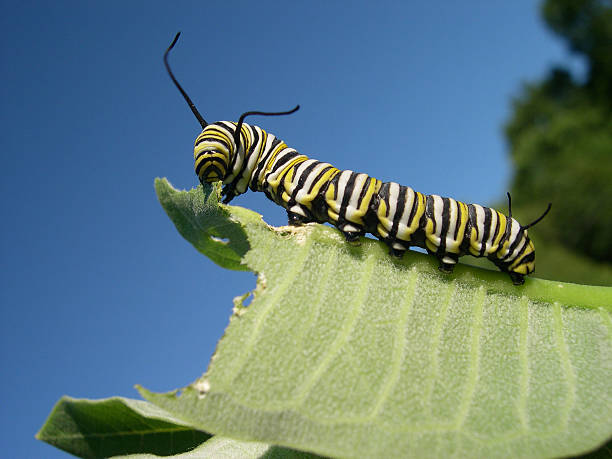
And monarch caterpillars employ an interesting strategy while eating, often chewing through a leaf vein before eating the leaf itself. Doing so causes the latex to spill out, which decreases the volume flowing to the leaf tissue, which the caterpillar then eats. This might represent an act of sabotage to the plant’s defenses, but research also suggests that monarchs might be seeking out the latex. After all, the milkweed’s toxins build up in the monarch’s tissues, making the monarch highly toxic to all but a few species that have similar adaptations to the monarch. The truth of why monarchs chew notches in milkweed leaves may also fall somewhere in the middle. Maybe the caterpillar has limits on how much cardiac glycosides it can handle. Maybe a heavy flow of latex makes it harder to eat quickly. Maybe sometimes monarchs just prefer their death salad with dressing on the side.
So now we’ve seen how monarchs specialize on milkweed. They aren’t the only species that use the plant, but as the milkweed goes, so goes the monarch.
Monarch Magic
If you enjoy graphic novels, post-apocalyptic stories, or monarchs (or any combination thereof), then I highly recommend Jonathan Case’s graphic novel, Little Monarchs.
The story centers on Elvie, a young girl living in world where changes in the sun have caused all mammals exposed to sunlight to die. The members of humanity left surviving are forced to live underground by day, and different groups either work together or fight for scarce remaining resources. Aboveground is a world where nature keeps on going as mechanical relics languish. Elvie’s guardian, a scientist named Flora, has discovered a cure for the sun-sickness using the scales of monarch butterfly wings. Elvie and Flora must undergo their own migration of sorts while they seek to find and rejoin Elvie’s parents. Like the butterfly, they must sustain themselves on the long journey and avoid dangers along the way.

The artwork is beautiful; the story is amusing, suspenseful, and wholesome in turns; and the book contains a lot of cool facts about the natural world and monarchs in particular. The story also reminds us that nature is an incredible resource, providing us with food, shelter, medicine, beauty, and a place to learn and explore.
Jonathan Case also champions the cause, encouraging readers to plant their native milkweed.
Side Quest: Find Your Native Milkweed and Grow It!
Why not grow some milkweed if you aren’t already?
Both the Xerxes Society* and Monarch Watch have excellent resources to help you identify species of milkweed are native to your area and help you find and grow them:
- Xerxes Society’s Regional milkweed guides for different parts of the U.S.
- Xerxes Society’s Milkweed Finder
- Xerxes Society’s Regional guides to nectar plants for monarchs
- Monarch Watch’s Milkweed Market
- Monarch Watch’s Milkweed Guide
- Monarch Watch’s Monarch Waystation Program
I’m trying my hand with a couple of species native to my area (Southeastern U.S.)**. Different species of milkweed have different preferences in terms of light, soil type, and moisture, so aim for species that will do best with the conditions you have.
Happy wildscaping!
*Despite sounding like a secret organization of potentially nefarious aims, the Xerxes Society for Invertebrate Conservation is a science-based international nonprofit organization dedicated to researching and protecting invertebrate species, not just the monarch. You can find out other vulnerable invertebrate species in the U.S. using state-specific search tools using the links found here.
**If you live in the central U.S. or Midwest, you’re an even better candidate due to habitat loss there.
 Go Wildscaping
Leave a comment