

In honor of Earth Day, today’s post features another plant swap-out.
This time, the bad plant is Autumn olive (Eleagnus umbellata), and the good plant is white oak (Quercus alba).
In case you aren’t familiar with Autumn olive (I just learned about it a month or two ago), it’s another super-invasive plant. The Georgia Invasive Species Council lists it as a category 1 invasive plant, which basically means it’s the worst of the worst. The Georgia Forestry Commission also hates this plant and offers recommendations for removal. Lots of other states recognize how bad it is, including Tennessee, Kentucky, West Virginia, Virginia, and Vermont.
Autumn olive shares a lot of the same negative characteristics as Callery pear (which Georgia also ranks as a category 1 invasive plant). If you’re curious, check out this other post on the Callery pear.
Fortunately, I don’t have any Autumn olive on my property. Instead, today’s swap-out story features my local public greenway. (Note: I obtained permission in advance.) The greenway is a fantastic place to walk, run, or bike. It’s also an interesting mix of older trees and shrubs and invasive baddies like privet and tons and tons of Autumn olive. I thought I’d give back to my community by working to remove a small amount of the Autumn olive with a super-plant, the white oak.
The white oak is beloved by humans and wildlife alike. Their wood can be used for everything from furniture, veneer, flooring, and wine and bourbon barrels to paper pulp. They add value to hunting lands because deer, hogs, and turkeys prefer white oak acorns, even over other oaks. They’re an incredibly important resource for caterpillars, which serve as a critical food source for almost all baby birds. According to this nifty Native Plant Finder tool, oaks are the number one best plant for caterpillar diversity in my area, supporting an impressive 447 different species and beating the next-closested contender (black cherry) by over 100 species. Oaks can support at least 557 different caterpillar species in other areas, too. And yet, the white oak is in decline. Why?
It’s true that white oak is sometimes harvested faster than it can be replenished. Deer overpopulation also presents a serious problem because deer will eat oak leaves in addition to acorns, killing young seedlings and saplings. (Deer hunting, while inhumane to some, is essential where no predators remain to keep populations in check.) But a big culprit is invasive species like Autumn olive, which out-compete the slow-growth white oak seedlings for sunlight. White oak decline has become such an issue that there’s literally an organization called the White Oak Initiative dedicated to protecting and regrowing white oaks.
With that background in mind, I decided to try replacing one of the worst-of-the-worst with one of the best-of-the-best.
I scouted our greenway for an area that had relatively young Autum olive trees that I could mostly uproot, as well as fair amount of sunlight from different angles. Here’s a picture of the spot before:

It took a lot of digging and sawing, but here’s a picture of the spot after (closer in and at a slightly different angle so you can see our tree better):
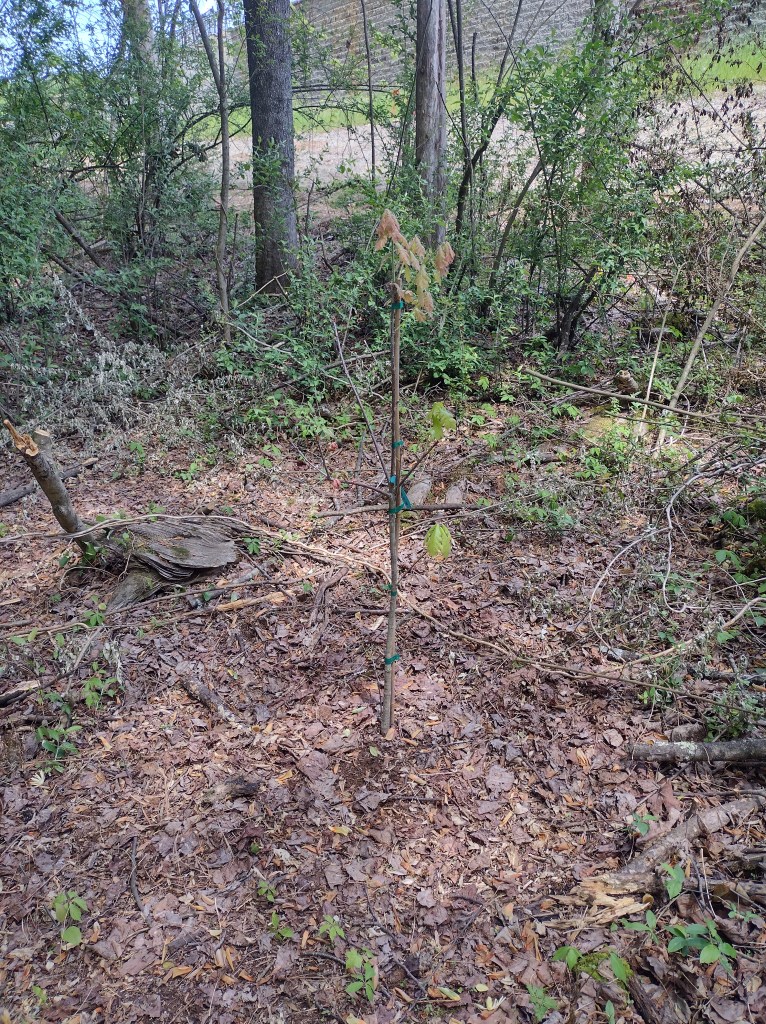
In the interest of full disclosure, I did this a couple of weekends ago. (Hey, Earth Day can be any day, really.) I’ve biked past the tree several times to monitor it, offer some water, and monitor for new growth of Autumn olive and privet, which was also present. So far, so good.
Happy planting!
 Go Wildscaping
Leave a comment