

One of the first places we added native plants to our yard was around the mailbox. This offered a few benefits:
- It gave us a small enough area so it didn’t feel overwhelming.
- It gave us a large enough area to add a few different species to experiment with and enjoy.
- We already visited this area almost every day, so it was easy to maintain.
- And since it was so front-and-center, it gave us an incentive to keep it looking nice.
Not everything survived our original plantings. For example, I learned that Cardinal flower (Lobelia cardinalis) needs more water than we get by our mailbox, which is at the top of a slope. Deer and rabbits also ate every black-eyed Susan (Rudbeckia sp.), purple coneflower (Echinacea purpurea) and aster we planted.
But some species survived and thrived. Our showy goldenrod (Solidago speciosa), Narrowleaf Bluestar (Amsonia hubrichtii), and a few types of coreopsis are still going strong and have even expanded. Partially because of this, we gradually expended the bed to cover a larger area and include more plants. Some additions have done especially well, including mountain mint (Pycnanthemum virginianum) and butterfly weed (Asclepias tuberosa). We most recently added the native grasses Pink muhly (Muhlenbergia capillaris) and little bluestem (Schizachyrium scoparium), plus a blueberry (Vaccinium virgatum) and another try with black-eyed Susans.
I’ll admit, though, it’s a work in progress. Sometimes it’s one of the most beautiful beds in our neighborhood. Sometimes it’s absolutely not.
Here’s a picture of the front of it:
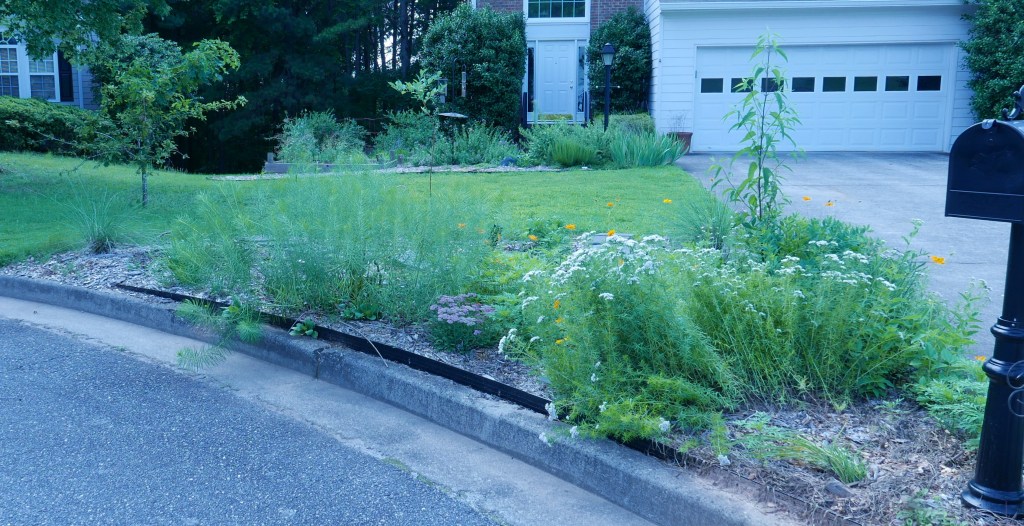
- I love the diversity of plantings, and you can’t see it from the photo, but there are dozens of pollinators all over these flowers.
- I recently dug up daffodils that took up the area closest to the mailbox, and that area looks a little scraggly.
- The border also stops randomly where we expanded the bed. Oops!
- The Narrowleaf bluestar is leaning over into the road in some areas. I’m debating whether to cut it back now or wait and gather the seeds from it and plant it farther back. I really like this plant en masse.
- The blueberry in the back needs some time to fill in, but I’m hoping it will be a focal point as it grows.
And here’s a picture of the back:
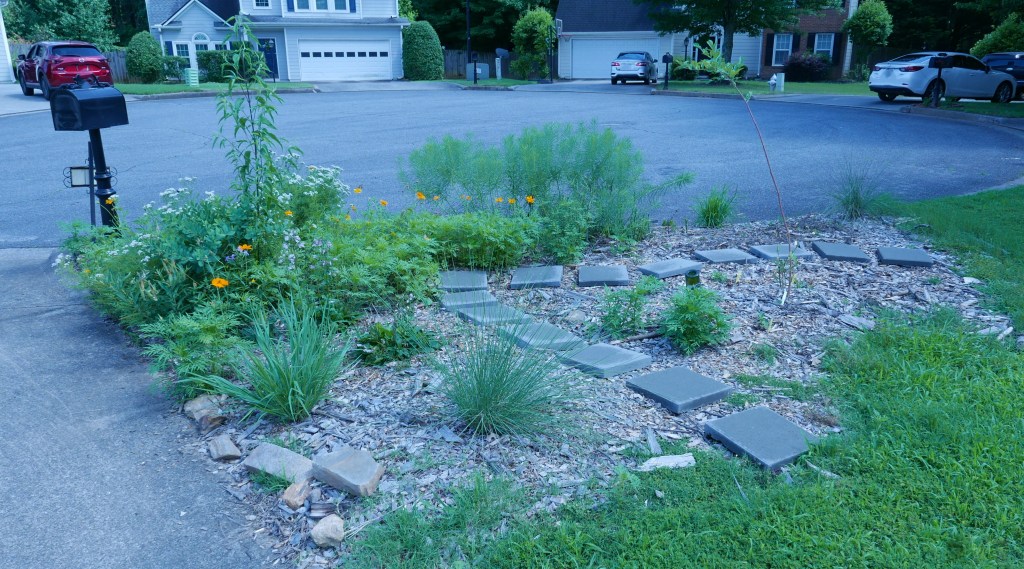
- The grasses are filling in nicely, but there are some bare patches to resolve. Or maybe I planted everything too close – who knows?
- You can see the blueberry in the back. Hang in there, buddy! (Blueberries can have striking fall color and attractive winter bark once they get a little larger.) I underplanted with black-eyed Susans, but these appear to be a deer/rabbit favorite. Sometimes I have to learn lessons multiple times…
- The stepping stones are a work in progress. I haven’t finished placing them, which is why they’re currently floating on the mulch. I wanted a way to access even the centermost part of the bed, and they also signal that this is an intentional, cared-for area.
- I love the lush area at the front. The white flowers are mountain mint and a specimen of wild quinine (Parthenium integrifolium); the pink flowers are calico beardtongue (Penstemon calycosus), yarrow (Achillea miillefolium) and some type of phlox I rescued; and the orange flowers are a few lingering stands of butterfly milkweed plus several volunteer cosmos left over from a wildflower seed mix experiment. (Note: cosmos aren’t native to North America.) Here’s a closeup below. Bonus points for every pollinator you spot.

Also, I’m not really qualified to give gardening advice, but I can recommend the following:
- Familiarize yourself with your yard and the growing conditions of different areas. How much light, water, and wind/cold/heat exposure do these areas get? Try to find plants that match the conditions.
- Start small.
- You’re allowed to change your mind. Plants can often be relocated, and if you don’t like something, you’re allowed to get rid of it.
- A mix of different species is nice, but a mass of one or two types of a plant often look more cohesive and impressive, particularly when in bloom. (Haha, I didn’t follow that advice for the mailbox bed.)
- I try to keep the areas closest to the mailbox lower-growing so our mail delivery person isn’t swarmed with bees or leaf stalks when they try to delivery the mail.
So it’s not Better Homes & Gardens worthy, but it makes me happy. 🙂
 Go Wildscaping
Leave a comment